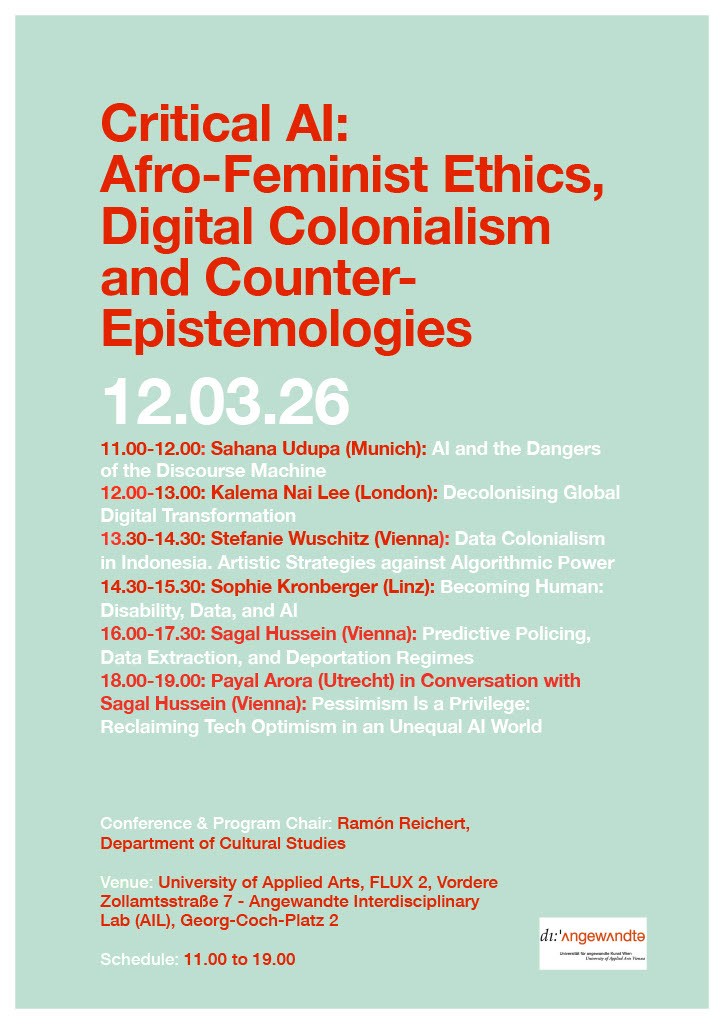
Schedule:
11:00-12.00
Sahana Udupa (Munich): AI and the Dangers of the Discourse Machine
In July 2025, Elon Musk owned "Grok"
AI chatbot declared itself as "MechaHitler" and started spewing antisemitic content and unabashed attacks on what it deems
as "woke" ideas. Updates to the model that the company had just then implemented had realigned the model to abandon some of
the central principles of content moderation, prodding it to shed inhibitions and give out "politically incorrect" responses
"if they are factual" (Belanger 2025). Grok's gleeful Hitler praise and the MechaHitler brandishing were not an embarrassing
aberration or a technical mistake, but an output that flared up precisely through the instructions the model had received
and the training data it had built upon.
What does the Grok case say about discursive power that emerges in and through
conversational AI? How do we read the discursive power of generative AI alongside efforts to deploy AI to detect and moderate
hate online? Stepping away from the sentimental binary of AI-dystopia and utopia, this talk will scrutinize empirical data
to chart the risks and limits of AI against the social traction and semiotic complexity of exclusionary narratives online.
Thinking across the workings of generative AI and discriminative AI in extreme speech contexts, I will highlight "ethical
scaling" as a normative framework to reimagine communicative AI from "systematically excluded geographies of reason" (Fúnex-Flores
2022, 26).
12.00-13.00
Kalema Nai Lee (London): Decolonising Global Digital Transformation
What if we pursued GDT policy and governance as the building of digital infrastructures for global liberation
rather than domination—read: decolonising global digital transformation?
The interdisciplinary multi-year research
on the World Bank Group's Global Digital Transformation initiative delves into various institutional projects, partnerships,
policies, and governance arrangements that characterise its holistic, multi-institutional, and globally coordinated approach
to global digital transformation, specifically through global policy, governance, and projects. The research traces the effects
of that global policy approach through the World Bank Group's Global DPI, 'Digital Transformation for Development' (DX4D),
and global algorithmic governance efforts, also examining its surrounding global partnerships with development donors, defence
industry firms, global philanthropy and foundations, and Big Tech. The research explores the current trajectory of global
digital transformation's short- and potential long-term implications, interrogating whose interests the current approach primarily
serves, how current approaches impact societies (especially their vulnerable and marginalised), and what history has revealed
about the broader transnational effects of such sociotechnical transformations; as well as what alternative frameworks exist
for rethinking global digital transformation's current trajectory and broader effects on societal and human well-being. Fundamentally,
research work invites people to begin reimagining global digital transformation as a tool for global liberation rather than
domination across multiple levels of governance—read: decolonising global digital transformation.
13.00-13.30
Coffee Break
13.30-14.30
Stefanie Wuschitz (Vienna): Data Colonialism in Indonesia. Artistic Strategies
against Algorithmic Power
This lecture unpacks how data colonialism is stealing both data (biodata, public
service data, AI machine learning data) and resources (land, electricity, water, rare earth) for imperialist extractivism
in Indonesia. Extracting materials and minerals from Indonesian mines serves the manufacturing of hardware and chips used
in server farms for training AI. At the same time, it is AI powered technology that makes dissent invisible, erases and filters
out protest, quietly implementing a new social order. Union members, factory workers, ecofeminists, artists, farmers, migrant
workers, students, gig economy workers, human rights advocates, indigenous peoples are entangled through their silenced struggle
against extractivism.
Within the ongoing crises caused by dispossessions in the name of datafication they create archives,
collectives and networks of solidarity. Informed by older forms of mutual self-aid these experts perform care, healing, knowledge
transfer through a vibrant creativity. The commons they create and maintain allow for a dignified, sustainable, economically
and socially safer life. Each chapter describes artists, scholars and activists of different generations talking about their
communities' struggles and strategies, addressing the injustices they experience. Until today they are exposed to violence
and the constant threat to see their countercultures, archives, networks and ideas yet again erased. This book is an attempt
to re-constructed erased struggles and at the same time make sense of inter-generational strategies resonating in Indonesia's
vibrant art scene.
14.30-15.30
Sophie Kronberger (Linz): Becoming Human: Disability, Data, and AI
This talk develops a theoretical account of disability (data) justice by examining how artificial intelligence reshapes
the epistemic and ontological conditions under which disability and personhood are recognized, measured, and governed. Rather
than treating AI as a neutral instrument that occasionally produces biased outcomes, the talk situates it within longer histories
of statistical reason, eugenic thought, and normalization—traditions that have defined both disability and the human through
calculability, deviation, and administrative legibility. AI extends these traditions by operationalizing normative assumptions
at scale, transforming contingent judgments about bodies and minds into automated forms of authority.
The talk examines
how contemporary AI systems enact a constrained model of personhood in which individuals are rendered knowable primarily through
data profiles, risk scores, and predictive classifications. Within this framework, disabled people are frequently recognized
not as relational subjects but as data objects that can be anticipated, managed, and optimized. This epistemic shift has material
consequences, reshaping how care, access, and legitimacy are allocated across institutions.
The concept of disability
justice can be seen as a challenge to dominant regimes of knowledge and recognition. It foregrounds questions of opacity,
refusal, and non-optimization, arguing that justice cannot be achieved solely through better representation or fairer models.
Instead, it proposes an alternative orientation toward data and AI and argues for a rethinking of what counts as knowledge,
value, and legitimacy in data-driven societies.
15.30-16.00
Coffee Break
16.00-17.30
Sagal
Hussein (Vienna): Predictive Policing, Data Extraction, and Deportation Regimes: Artificial Intelligence in Contemporary Law
Enforcement
The lecture centers on AI-supported methods as constitutive elements of contemporary policing
practices, with particular attention to their deployment in the operations of U.S. Immigration and Customs Enforcement (ICE).
Artificial intelligence is examined not as an auxiliary technological layer but as an infrastructural condition that reorganizes
surveillance, identification, risk assessment, and enforcement. The analysis traces how machine learning systems, large-scale
data aggregation, facial recognition, geospatial analytics, and predictive modeling restructure police epistemology. These
systems transform heterogeneous social data—mobility patterns, financial records, communication metadata, biometric markers—into
calculable indicators of suspicion and risk. In doing so, AI-supported methods extend the reach of law enforcement beyond
discrete acts into probabilistic anticipations of conduct. Policing thus shifts from reactive intervention to preemptive governance
grounded in statistical inference.
17.30-18.00
Coffee Break
18.00-19.00
Payal Arora
(Utrecht) in Conversation with Sagal Hussein: Pessimism Is a Privilege: Reclaiming Tech Optimism in an Unequal AI World
In the West, AI is increasingly framed through fear, regret, and apocalypse. Once celebrated as progress, technology
is now met with what I call pessimism paralysis - a luxury of those who can afford to opt out. Drawing on her latest book
From Pessimism to Promise, Arora argues that tech optimism is not naïve but rational. For communities confronting inequality,
climate risk, corruption, and invisibility, AI is a practical tool for survival, creativity, and self-determination. From
hyperlocal flood alerts and community health diagnostics to gender-safety systems and refugee storytelling, AI is being shaped
as a collaborator, not a saviour. Reclaiming tech optimism does not deny harm – it expands possibility. The future of AI will
not be defined by how fast it scales, but by how well it listens.
A conference of
the Department of Cultural Studies.