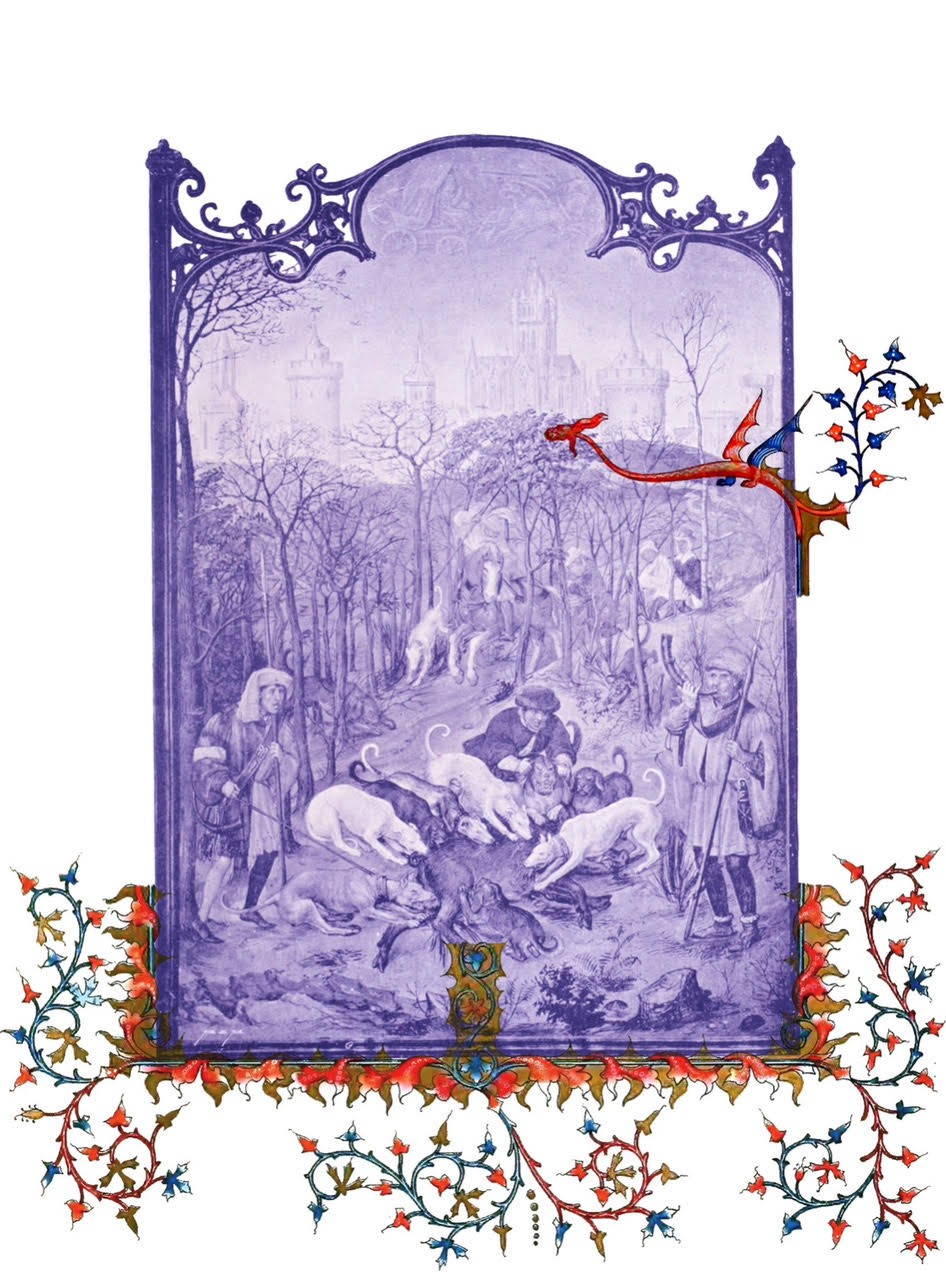
The Book of Hours as Transitional
Object
When mother and child leave the stratified space between landscape
and still life, the space that
remains folds in on itself, into genre,
and continues to divide from there. In doing so, they leave the
painting
behind like two halves of a sandwich—only with the topping missing in the middle. From
then on, this topping, or rather these topoi, will accompany painting as an absence, an absence
that will be replaced by ever new substitutes. For example,
conflicts of content.
But first, still life. When media appear obsolete, they transform
into their own drag version: in
recognizing its limitations, each finally
becomes aware of itself. (Becoming self-aware here means
becoming
your own problem. Unable to believe in your former significance, you fail to be what you
are and become what you always wanted to be: your other.)
When
books become printed matter, they dream of rising from the table, shaking off the scattered
petals they had just so laboriously draped over themselves. They would rather become the whole
plant, a curtain, topologies, thresholds. The false dragonflies
should settle down, so real do the
hallucinated blossoms want to be. They
want to be all of these things at once, that is, to be
painting.
Painting, in turn, wants to end its own chapter as quickly as possible right at the
beginning, turn the page on itself and move on. So it paints its own reverse, an anti-image, a
screen. Something always has to protrude, get away. “The still
life is a fringed edge that has gone
wild, that has become independent, that
has conquered the entire space of representation,” as
Bernhard
Siegert and Helga Lutz call it.
The days pass as we perform our daily lives, like turning the
pages of a book of hours that has lost
its meaning, but whose emptied rhythms
we continue to unconsciously carry on. Or not. In the
empty
cathedrals of what remains sacred to us, winter becomes spring becomes summer becomes
autumn—while the ruins of reality are within and all around. Mise en abyme … what is that actually,
the painted abyss of painting? What is repeated again and again
in painting, revealed in the
process of change, and what is hidden
through it (through hegemonies and clichés ...), made
unconscious,
‘naturalized’? The artificial flowers frame the abyss of images we project or receive. I
want to drown your images of the present in the flowers of the past.
//
There are texts that make you look at images differently: “Metamorphosen der Fläche” (2011) by
Bernhard Siegert and Helga Lutz is one such text; Victor Stoichita
“The Self-Aware Image” (1993) another. Both describe this initial self-problematization of images as an open space of negotiation
of contradictions). We want to explore this and ask in what form it appears today, or rather, what can still be made productive
from it. In short, how the old problem (the primal fantasy of painting)
could
speak to us, still. A question we begin to ask with this first exhibition, “WINTER: Still Life”,
and which we will continue to explore in four stages throughout
the year. The next being “SPRING:
Imperial Landscapes”.
Participating artists:
Raihana Akbary, Sophia Balog, Hanna Berrio, nathan c'ha, Franky
Daubenfeld, Ela Deniz Demir, Gregor Divizenz, Somebody Foushku, Isabelle Gray, Deniz Amber
Kinir, Anne Kleinjan, Luise Knecht, Daniela Kuich, Chattip
Metchanun, Kimia Nazari, Neva Eda
Özkan, Emil Puchner, Laurin Schuh, Evgeny
Tantsurin