In the exhibition “discrepancies with W.W. (in company)”, the Portuguese artist explores
materials and the history of (Viennese) arts and crafts.
The University Gallery of the Angewandte
presents the first solo exhibition in Vienna by the Portuguese artist Leonor Antunes. In discrepancies with W.W. (in company),
Antunes places her own artistic works in dialogue with pieces by designers from the Wiener Werkstätte and the former Imperial
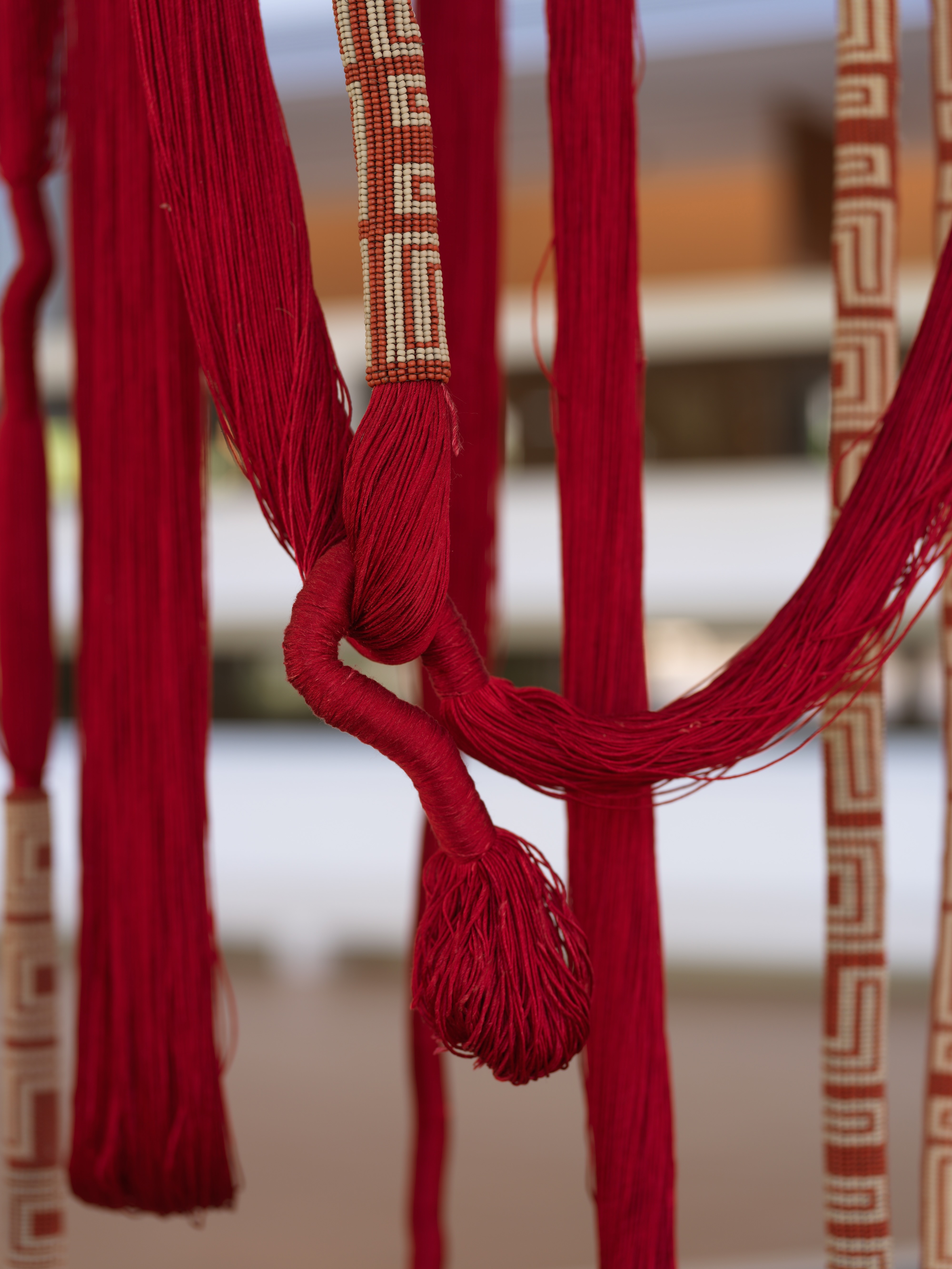
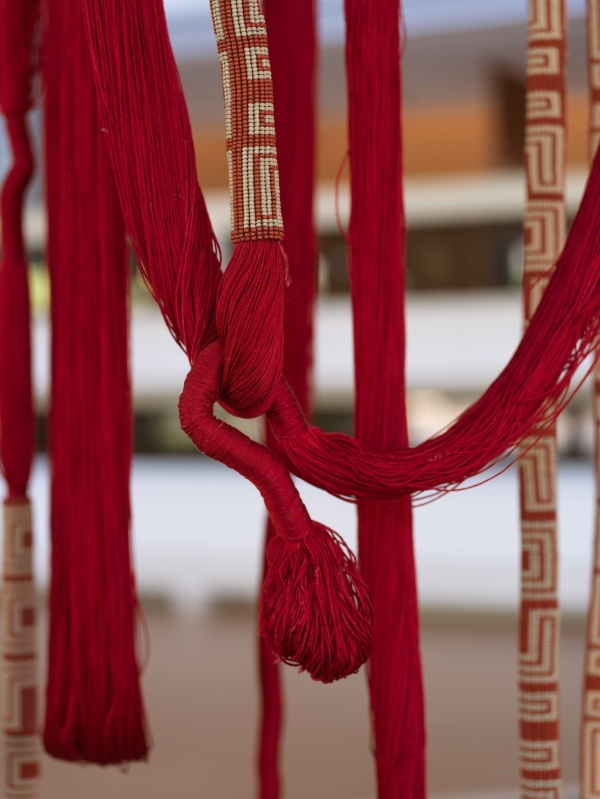
and Royal School of Arts and Crafts. Antunes’ use of glass beads, ropes, wood and steel resonates with the materials and craftsmanship
of selected objects from the collections of Angewandte's Collection and Archive.
Leonor Antunes’
interest in the historical developments and key figures of 20th-century art, craft, design and architecture forms the conceptual
framework for her artistic practice. At the same time, she sees her work as a tribute to designers who have often been overlooked
or marginalised. This forms the backdrop to her in-depth research, which, however, does not remain confined to a historical
and theoretical level, but involves close collaboration with professional craftspeople to develop new approaches and methods
for working with specific materials in her artworks.
Antunes’ extensive knowledge and her archive flow into her own
sculptures and installations, in which she integrates materials such as rope, wood, leather and brass. The nature of an exhibition
space is of the utmost importance to the artist. The floor and ceiling, as well as the light source—be it natural or artificial—play
just as significant a role as the exhibited objects. Antunes: “I firmly believe that art exists within a context; therefore,
I do not view my sculptures as existing outside the spaces in which they are situated.”
With regard to Vienna, Antunes
has previously engaged with the Wiener Werkstätten and the Austrian painter, graphic artist and textile designer Felice Rix-Ueno
(1893–1967). During her research in the collections of the Angewandte, Antunes focused on female artists and designers such
as Gudrun Baudisch, Rosa Bonom, Friedl Dicker-Brandeis, Mathilde Flögl, Lilly Jacobsen, Erika Giovanna Klien, Felice Rix-Ueno,
Hilda Schmid-Jesser, Maria Strauss-Likarz, Margarete Schütte-Lihotzky and Vally Wieselthier.
For discrepancies with
W.W. (in company), Antunes has designed a visually multi-layered exhibition system that forms small display islands within
the rooms. The basis for this is a chair designed by the French architect and designer Charlotte Perriand (1903–1999) following
a working visit to Japan in the early 1940s. In doing so, Antunes also draws attention to the connection between Japanese
craftsmanship and the Wiener Werkstätte, of which Felice Rix-Ueno, among others, was a member until 1930. Rix-Ueno worked
in both Kyoto and Vienna.
Constructed from wooden elements, Antunes’ exhibition system is potentially adaptable and
expandable. The chair’s everyday function as a seat is transformed into a plinth and a hanging mechanism. Further exhibition
elements include tatami mats, which the artist integrates or arranges into a geometric platform. Displayed on these modular
surfaces are collection objects selected by the artist, such as ceramic vessels and textiles with geometric patterns. She
places her own works in relation to these. On display are, among other things, sculptures from the series “Sophie” (2024),
which draw their inspiration from drawings, beaded bags and necklaces by the Swiss artist and designer Sophie Taeuber-Arp
(1889–1943), as well as “Felice and Charlotte” (2025), which reference Rix-Ueno and Perriand.
Interlocking strands of
glass beads in geometric patterns, varying in colour, thickness and length, are interwoven with vertical white steel rods
or narrow, elongated pieces of wood.
Antunes’ overarching aim for her exhibition “discrepancies with W.W. (in company)”
is to create a dialogue between her own artistic works and specific objects from the art collection and archive of the University
of Applied Arts Vienna, whilst taking into account the overall idiosyncratic interior of the former prelature in the Heiligenkreuzerhof.
Here, several highly specific levels of temporality, form and materiality converge, prompting reflection on the codes of representation
and the domestic, on modernism and abstraction, contemporaneity and synchronicity. Leonor Antunes thus claims for herself
an interdisciplinary freedom that she already finds in the pioneering artistic practices of the early 20th century.
Our
thanks for the loans and generous support go to the Art Collection and Archive of the University of Applied Arts Vienna, as
well as to the galleries Kurimanzutto, Mexico City and New York; Marian Goodman Gallery, Paris and New York; and Taka Ishii
Gallery, Tokyo and Kyoto.
Artist’s biography
Leonor Antunes (born 1972 in Lisbon, Portugal; lives
and works in Lisbon and Berlin) initially studied at the Escola Superior de Teatro e Cinema in Lisbon. In 1993, she completed
her studies in Fine Art and Sculpture at the Faculty of Fine Arts of the University of Lisbon and went on to the State Academy
of Fine Arts in Karlsruhe, Germany, in 1998. Her works have been shown in numerous solo and group exhibitions worldwide. Her
most recent solo exhibition was “the constant inequality of leonor’s days*” at the CAM-Centro de Arte Moderna Gulbenkian,
Lisbon, Portugal in 2025. Antunes designed the Portuguese Pavilion at the Venice Biennale, Italy, in 2019 and participated
in the Sharjah Biennial, United Arab Emirates (2015) and the 8th Berlin Biennale (2014).
Exhibition details:
Leonor
Antunes
discrepancies with W.W. (in company)
Curated by Julienne Lorz
26 March – 4 July 2026
Opening:
25 March 2026, 6.00 pm
University Gallery of the University of Applied Arts, Refectory
Heiligenkreuzerhof, Staircase
8, 1st floor, 1010 Vienna
Access via Schönlaterngasse 5 / Grashofgasse 3, 1010 Vienna
Opening hours: Wednesday–Saturday,
2.00 pm–6.00 pm
Closed on public holidays. Free admission.
Details of the accompanying programme: universitaetsgalerie.dieangewandte.at