Can
art and fashion respond to current social, economic, cultural and en-vironmental urgencies and shape new paradigmatic positions?
Transfashional explores the ways in which artists and designers are engaging and contributing to these questions.
Transfashional began as a series of collaborative sessions with fashion designer
Hussein Chalayan, curators
José Teunissen (Arnheim Fashion Biennial),
Susanne Neuburger
(MUMOK − Museum moderner Kunst Stiftung Ludwig Wien),
Barbara Putz-Plecko and
Beatrice Jaschke
(Die Angewandte) as well as emerging artists and designers whose practice is situated in between fashion and art. This project
encouraged collaborative and experimental work which resulted in new productions and transcended boundaries between disciplines.
As this emerging generation of artists and designers reflect on the world around them, they highlight the need for
a profound revision of the pro-cesses of production and social relations which derive from them. They turn away from the fashion
industry and it’s super-accelerated rhythms of production. Their quest for alternatives drives and inspires new productions
− not of goods but of ideas. Indeed, more than wearable and functional, many of these works are critical, engaged and conceptual,
and can be seen as symbols and symptoms of the present zeitgeist.
UK based artist
Lara Torres
asks the viewer to stop and reflect about how we make fashion in the future in her video-essay Unmaking. The visual narrative
is composed of a series of performative gestures, such as un-weaving, un-sewing and tearing apart in order to become aware
of the symbolic meaning of the thread, of the fragment, and of all what remains behind as a material trace of human existence.
In a similar way
Anna Sophie Berger’s work She Vanished 1 evokes absence, loss, and generally the state of
moving away while
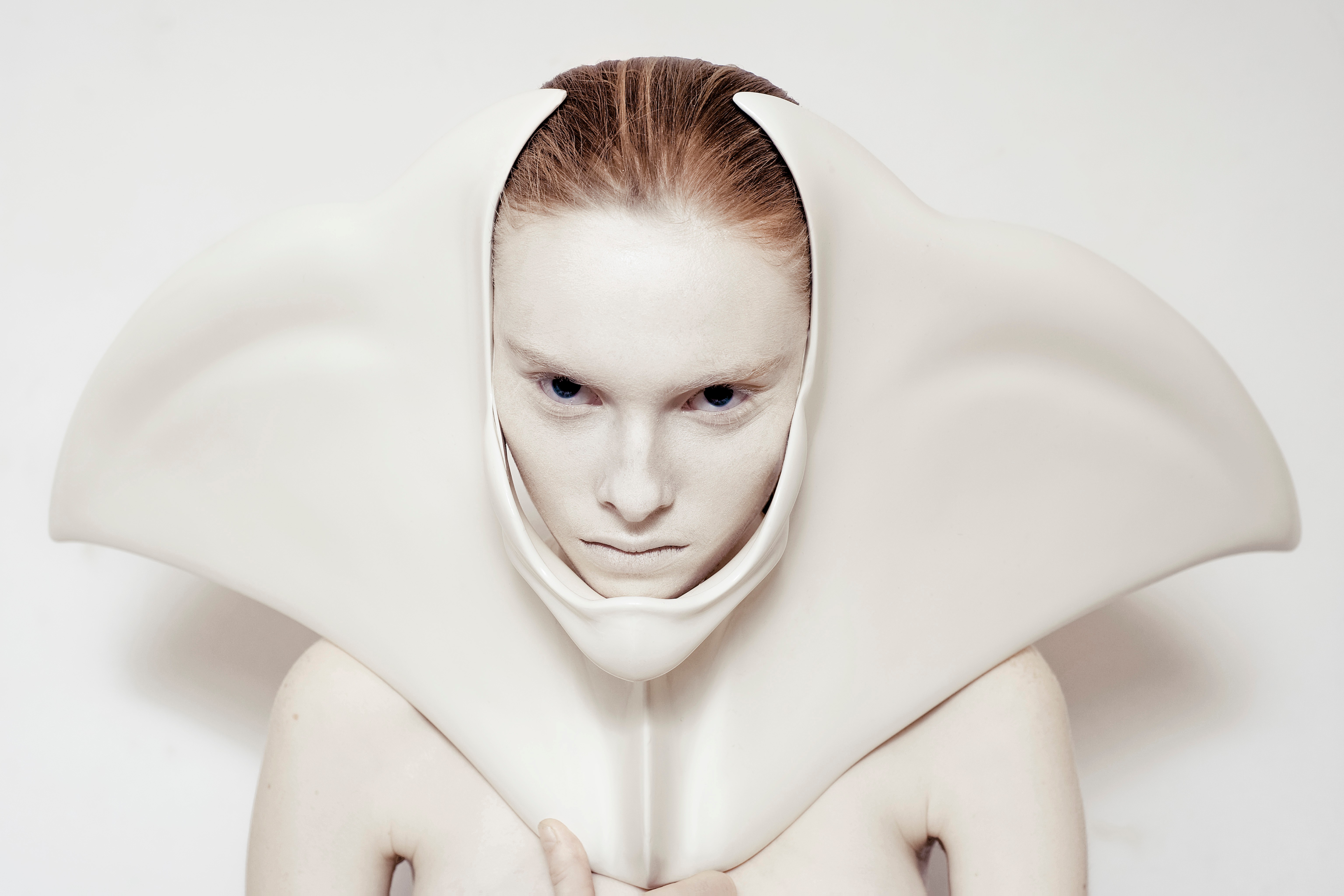
Ana Rajčević’s work questions possible new beginnings: her wearable sculptures in the form
of long horns invoke both ancestral and futuristic dimensions.
Kate Langrish-Smith pushes the notion of wearability
and functionality even further. Her body-related-sculptures function as enigmatic performative devices which create specific
choreography of the movement and body-posture, inviting and teasing spectators to interact with them. By means of an artistic
analysis
Manora Auersperg reflects on the exhibition itself. She traced the spatial evolution of the exhibition
in different sites, intervening on the textile surface by pulling out threads. Whereas the given structure of the fabric dissolves,
notes materialize in a different medium. Now the work will enter in the third stage, in which a camera, specially built by
artist
Konrad Strutz, will be used to scan/read the surface of textile and transform it in yet another form
of “text/texture”.
Several artists focus on the potential of materials.
For her collection Excuse My
Dust
Christina Dörfler-Raab, in collabora-tion with
Jasmin Schaitl, experiments with different
dying processes u-sing destructive and corrosive substances, facilitated through the creation and transformation of objects
and implementation of various performative formats and actions.
Afra Kirchdorfer creates modular systems
composed of ribbons and ge-ometrically cut pieces of cloth which can be endlessly combined and re-combined around the body.
Assembling the work becomes a playful action of re-designing as well as rethinking the very notion of ready-to-wear. Graphic
designer
Maximilian Mauracher created a project entitled NOUS002, a follow-up to his interactive installation
at Transfashional Lab London. His artificial intelligence, an automated combination of various digital tools made for image
recognition, manipulation and creation, produces an almost endless flux of computer-generated imagery. The installation shows
a small selection of its experiments with patterns and silhouettes and visualizes its future potential.
Janusz
Noniewicz, Dominika Wirkowska, Wojciech Małolepszy and
Robert Pludra, together with a group of students
from fashion and product design departments of Warsaw Art Academy, will present complex video animation and set of interactive
installations inspired by celebrated Austrian author Robert Musil's novel Die Verwirrungen des Zöglings Törleß. Their work
revolves round the position of being active or passive, both as a citizen and as a creative person in relation to one’s social,
political and cultural surrounding.
Also collaborating on a new work are
Anna Schwarz and
Lisa
Edi who explore the dialectical relation between the “eye” of the camera and ob-ject of its focus.
Transfashional
(8.12. − 20.12.2017) is organised by the University of Applied Arts Vienna in collaboration with Austrian Cultural Forum Warsaw,
Austrian Cultural Forum London, Academy of Fine Arts in Warsaw and London College of Fashion and with the additional support
of the Federal Ministry for Arts and Culture, Constitution and Media, Austria.
Artists & designers:
Manora
Auersperg & Konrad Strutz, Anna-Sophie Berger, Christina Dörfler-Raab & Jasmin Schaitl, Lisa Edi, Afra Kirchdorfer,
Kate Langrish-Smith, Maximilian Mauracher, Ana Rajčević, Anna Schwarz, Lara Torres, Janusz Noniewicz, Dominika Wirkowska,
Wojciech Małolepszy, Robert Pludra, Fashion and Product Design departments of the Academy of Fine Arts in Warsaw, Margarita
Slepakova, Clemens FiechterCurated by:
Dobrila Denegri
Öffnungszeiten:
Mo – So, 13 – 20 Uhr
Follow:
http://transfashional.comhttps://www.instagram.com/transfashional/https://www.facebook.com/transfashional/?pnref=story