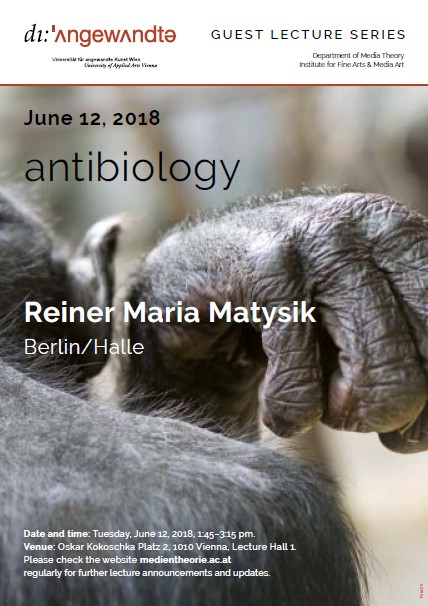
Artist Talk - Medientheorie: Reiner Maria Matysik
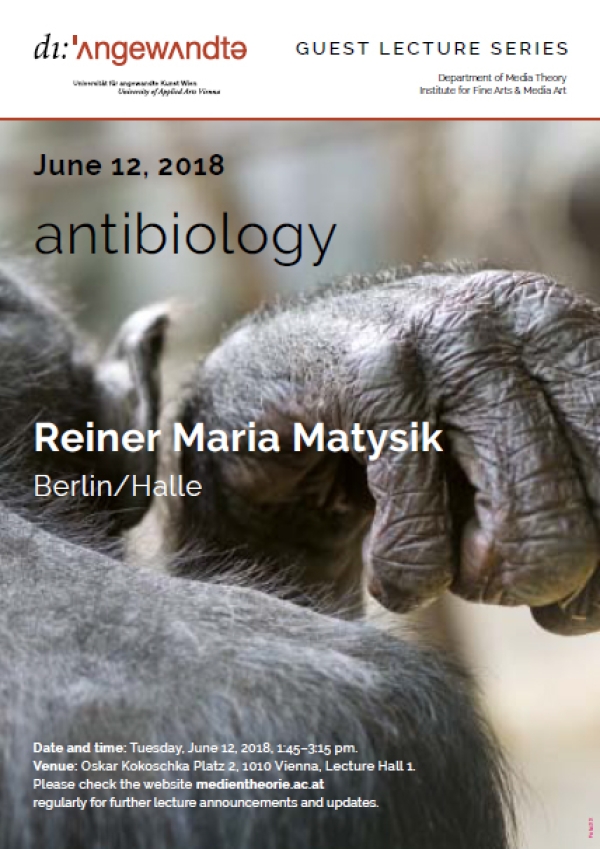
Medientheorie: Reiner Maria Matysik, Berlin/Halle
On June 12, 2018, Reiner Maria Matysik a Berlin-based artist and professor of three-dimensional design
at the University of Art and Design in Halle (Burg Giebichenstein), Germany, will give an artist talk about antibiology (see
the German version below):
Whether we like to admit it or not — humans are becoming plants more
and more. Sculpture is not talk. Sculpture is doing. Sculpting is the practical pictorial work of our hands with real materials
and objects. Sculptural work facilitates experience with all kinds of materials. Sculptures allow one to understand the interdependence
of form and material. This is the power of sculpture to unlock the world. Is there an objective or scientific frame of reference
for the field of sculpture? Is there, beyond the conventions of bourgeois art or political-pedagogic manipulation, a foundation
of sculpture? Ist genesis, determined by physico-biological processes, is possibly such a field. In nature, forms develop
through forces that are independent of human work and influence. The comparison of sculptural objects with such morphogenically
produced structures enables understanding of forms. The form and structure of inanimate matter not produced by humans as well
as living creatures are connected to the context of mathematics, physics, and mechanics. Sculpture is the comprehension of
such forces that loses itself mimetically.
In short, if we want to, we will not find our way to design. Also, own
experience shows that when one sculpts, the material takes over control. In the end, we do not really know what we are actually
doing. The work is not smarter than its creator, although it takes possession of her/him. The least one can say of giving
form to something is that it is an experiment in which what is formed distances itself from ist creator. When we create, we
become open to our limitations in order to constitute them through this act of opening. Creating does have a subject. However,
it articulates itself in the subject forgetting herself/himself in the action of doing and intervening.
For this
reason we are obliged to ask questions about our existence that go beyond art. I shall not attempt to answer these questions
theoretically, but explore them through my work. Using Joseph Beuys’ concept of social sculpture, we will not make any progress.
Today’s necessities are different. Therefore, we will have to shift it, specialise it, and render it more precise. For this
reason, I have replaced social sculpture with the concept biological sculpture. My own works are tokens of the quest upon
which I have embarked. I shall now attempt, with a selection of my works, to demonstrate what I understand by biological sculpture
(Reiner Maria Matysik, Berlin and Halle).
Reiner Maria Matysik is a Berlin-based artist and a professor of three-dimensional
design at the University of Art and Design in Halle, Germany (Burg Giebichenstein). He studied fine arts at the Hochschule
für bildende Künste Braunschweig and at the Ateliers Arnhem. He works in manifold ways with concepts for future landscapes
and organisms, such as post-evolutionary life forms. Through the specific adoption of object, installation, and video he developed
a dynamic scenario of future landscapes and organisms. In this way he creates an area of conflict between promise and failure
in a potential future. Both the visual implementation and their linguistic form can be recognised here as the essential artistic
strategies which he uses as his own interface between the worlds of scientific research and pseudo-scientific fiction. In
2004 he directed the artistic development project Institute of Biological Sculpture at the Hochschule für bildende Künste
Braunschweig. He was a lecturer at the Institute of Visual Arts, Faculty of Architecture, Technical University Braunschweig,
and from 2008 to 2009 visiting professor of sculpture at the Fachhochschule Kunst Arnstadt.
He has exhibited his
artworks at institutions such as the Gerhard-Marcks-Haus, Bremen; Centre Pasquart, Biel, Switzerland; Neue Gesellschaft für
bildende Kunst, Berlin; Projektraum deutscher Künstlerbund, laboratoria moskau; Museum Koenig, Bonn; Georg Kolbe Museum and
Künstlerhaus Bethanien, Berlin; Staatliche Kunsthalle Baden- Baden; Fondación Cesar Manrique, Lanzarote; Kunstverein Hannover;
Martin-Gropius-Bau, Berlin; Kunsthalle Bern, Switzerland. He is the recipient of grants from the Studienstiftung des deutschen
Volkes, Kunstfonds e.V., DAAD, KfW Bank, Stiftung NORD/LB Öffentliche, and the Senate of Berlin.
The Guest Lecture
Series of Professor Ingeborg Reichle’s lecture Speculative Biologies: New Directions in Art & Biotechnology is an informative
and stimulating opportunity to hear from distinguished artists about what’s going on in the emerging fields of bioart, biodesign
and speculative biology and also helps our students to build their network of contacts. Speculating about how “life” and “nature”,
or what "human" and "animal" could be in the near future is an apposite cross-disciplinary approach to collectively rethink
how we want our future to be and what kind of aspirations will be possible or even probable under the auspices of turbo capitalism
and mass consumerism.
antibiology
whether we like to admit it or not — humans are becoming plants more
and more.
plastik ist nicht reden. plastik ist tun. plastik ist die praktische bildnerische arbeit der hände mit
realem material und gegenständen. plastisches handeln ermöglicht erfahrungen mit verschiedensten materialien. in der plastik
lässt sich die wechselbeziehung von form und material begreifen. das ist die welterschließende kraft der plastik.
gibt es einen objektiven oder wissenschaftlichen bezugsrahmen für den bereich der plastik? gibt es jenseits von konventionen
wie der bürgerlichen kunst oder politisch erzieherischer manipulation eine plastische grundlage? die durch physikalisch-biologische
prozesse bedingte genese ist vielleicht so ein bereich. in der natur entstehen formen durch kräfte, die unabhängig von menschlicher
arbeit und einwirkung sind. der vergleich plastisch gestalteter objekte mit diesen morphogenetisch entstandenen gebilden ermöglicht
das verstehen von form. form und struktur von nicht von menschen gemachter unbelebter materie sowie der lebewesen stehen
in einem zusammenhang mit mathematik, physik und mechanik. plastik ist ein mimetisches sich verlierendes nachvollziehen solcher
kräfte.
verkürzt gesagt: wenn wir nur wollen finden wir nicht zum gestalten. auch die eigene erfahrung zeigt —
wenn man formt, übernimmt das material die führung. letztendlich wissen wir dann nicht was wir machen. das werk ist nicht
klüger als der gestalter, aber es nimmt von ihm besitz. das mindeste, das man vom form geben sagen kann, ist, dass es experiment
ist, das den gestaltenden von sich entfernt. Im gestalten öffnen wir uns unseren grenzen, um sie durch diese öffnung zu konstituieren.
es gibt ein subjekt des gestaltens. es artikuliert sich aber in der subjektvergessenheit beim selbst zugreifenden tun.
daher sind wir verpflichtet über die kunst hinausgehende fragen nach unserer existenz zu stellen. ich werde nicht
versuchen diese fragen theoretisch zu beantworten sondern sie an hand meiner arbeit zu ergründen.
mit joseph beuys
begriff der sozialen plastik kommen wir heute nicht weiter. die notwendigkeiten heute sind andere. daher müssen wir ihn verschieben,
spezialisieren und präzisieren. deshalb habe ich anstelle der sozialen plastik den begriff der biologischen plastik in die
welt gesetzt. meine eigenen arbeiten sind zeichen für die suche auf die ich mich begeben habe. ich versuche nun anhand einer
auswahl meiner arbeiten zu zeigen, was ich als ergebnisoffenes gestalten der biologischen plastik begreife (Reiner Maria Matysik,
Berlin/Halle).
Our guest lectures are open to all.