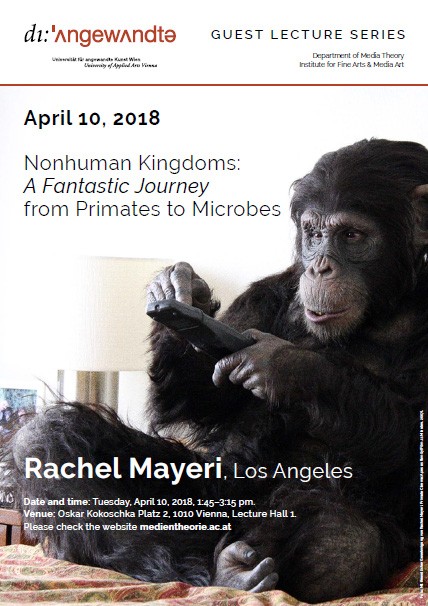
On April 10,
2018 US-American artist Rachel Mayeri will present in her artist talk on Nonhuman Kingdoms: A Fantastic Journey from Primates
to Microbes the excerpts from a series of video experiments about apes and monkeys entitled Primate Cinema, as well as more
recent films inspired by the microbiome and environmental degradation.
The study of nonhuman
primates and bacteria both de-center human identity, a process of alienation that is useful for art. The primate order places
human identity on a continuum with animals, enabling us to see unsettling similarities with other apes, and through research
and observation, to see our differences more clearly as we see animals as individuals rather than types. In Baboons as Friends,
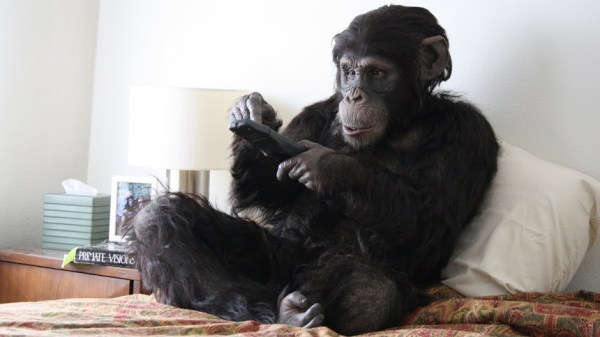
Rachel Mayeri “translates” field footage of a baboon sexual drama into a human film noir. In Apes as Family, she creates a
film for a captive chimpanzee audience. Her work with primates employs video as a mirror and a prism for viewing ourselves:
just as the “mirror test” is used to confirm whether an animal or baby has a “theory of mind,” an understanding of self and
other.
Primates evolved millions of years after microbes ruled and shaped the Earth. Microbes make up half of the
cells in the human body, and the majority of our DNA. Thus, the microbiome presents another threat to an anthropocentric view
of the world. Rachel Mayeri will show her recent film Orfeo nel Canale Alimentare, an animated opera about the gut microbiome.
Bacterial and fungal colonization of human bodies makes people ecosystems, deconstructing individualism, and obliterating
the division between the inner and outer environment. A through-line between the primate order and the bacterial kingdom has
been Donna Haraway’s work, whose stories about media, art, gender, biology, scientists, and environmentalism have encouraged
these conceptual leaps.
Rachel Mayeri is a Los Angeles-based US-American artist working at the intersection of
science and art. Her videos, installations, and writing projects explore topics ranging from the history of special effects
to the human animal. She is Associate Professor of Media Studies at Harvey Mudd College.
For the past several years,
Rachel Mayeri has been working on a series of experimental videos exploring the primate continuum entitled Primate Cinema.
In 2011, she received a major arts grant from the UK-based Wellcome Trust to make original videos to entertain captive chimpanzees.
The resulting project, commissioned by the Arts Catalyst, is called Primate Cinema: Apes as Family. There are two versions:
one is a 12 minute single channel video and the other is a 22 minute two channel video installation. The single channel video
was selected in 2013 for Sundance, Berlinale, True/False Film Festival, and Transitio Mexico Festival of Electronic Art. The
two channel version premiered at Abandon Normal Devices and was featured at the Edinburgh Festival of Art, and won a prize
for hybrid art at Ars Electronica.
Primate Cinema: Baboons as Friends (2007), is a reenactment of a baboon social drama
with human actors, produced in collaboration with primatologist Deborah Forster. Primate Cinema received a Semifinalist honor
for the International Science and Engineering Visualization Challenge (sponsored by NSF and The Journal Science) and showed
at the Museum of Contemporary Art in Denmark. Stories from the Genome: An Animated History of Reproduction was supported by
Creative Capital Foundation and won an “International Media Art Prize,” sponsored by ZKM. She programmed a DVD of videos by
artists and scientists entitled Soft Science (www.soft-science.org), which is distributed by Video Data Bank. As Guest Curator
at the Museum of Jurassic Technology, she contributed to an exhibit on the history of special effects, Miracles and Disasters
in Renaissance and Baroque Theater Mechanics. Her chapter on artists’ experiments with science documentary was published in
Tactical Biopolitics: Art, Activism, and Technoscience, edited by Beatriz da Costa and Kavita Philip (MIT Press. 2008).
http://rachelmayeri.com/The Guest Lecture Series of Professor Ingeborg
Reichle’s lecture Speculative Biologies: New Directions in Art & Biotechnology is an informative and stimulating opportunity
to hear from distinguished artists about what’s going on in the emerging fields of bioart, biodesign and speculative biology
and also helps our students to build their network of contacts. Speculating about how “life” and “nature” could be in the
near future is an apposite cross-disciplinary approach to collectively rethink how we want our future to be and what kind
of aspirations will be possible or even probable under the auspices of turbo capitalism and mass consumerism.
Our
guest lectures are open to all.