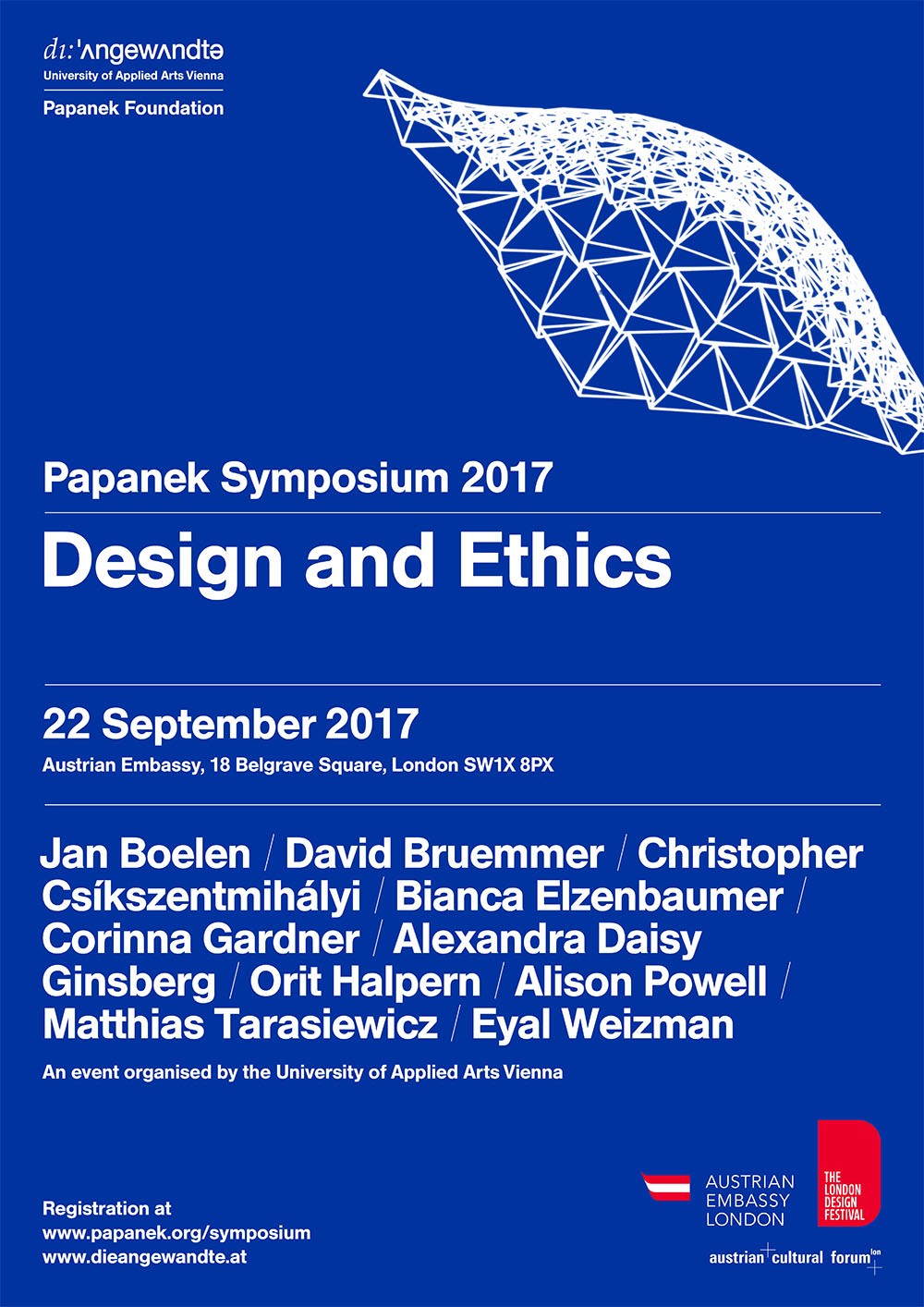
Questions of design and ethics take on a new currency, form and
prescience in a post-industrial, ‘post-truth’ landscape. The technological shifts that have re-organised work through the
automation of labour are intimately connected to global social problems relating to immigration, racial and gender politics.
New classifications of intelligence, ‘artificial’, ‘alternative’ and ‘false’, are produced and consumed through the design
and management of infrastructures of information. Meanwhile, new experts in algorithmic cultures, engineering and synthetic
biology pursue the application of these forms of intelligence in medicine, security, health and social care as practical solutions
to complex social problems.
Design and architecture occupy a powerful and precarious responsibility within
this complexity, which goes beyond mere application and facilitation. The Papanek Symposium 2017 considers the deeply embedded
social and political implications of design; a practice which can be so vulnerable to co-option and yet conversely so valuable
as a form of dissent. It explores the unique position of design practice and research- contemporary, historical and anthropological-to
address questions of ethics in design. Bringing academics and designers into dialogue, it aims to generate new ideas and critical
thinking on the state of ethics in design and architecture today.
Speakers include Jan Boelen (Z33, Belgium),
David Bruemmer (5D Robotics, USA), Prof. Chris Csíkszentmihályi, (Madeira Interactive Technologies Institute, Portugal) Dr.
Bianca Elzenbaumer (Leeds College of Art/Brave New Alps, UK), Corinna Gardner (Victoria and Albert Museum, UK), Alexandra
Daisy Ginsberg (Royal College of Art, UK), Dr. Orit Halpern (Concordia University, Canada), Dr. Alison Powell (London
School of Economics, UK), Matthias Tarasiewicz (RIAT, Austria), Prof. Eyal Weizman (Goldsmiths, University of London, UK).
Papanek Lecture 2017: The Architectural Sensorium Following the Papanek
Symposium 2017: Design & Ethics, Professor Eyal Weizman, Architect, Professor of Spatial and Visual Cultures
and Director of Forensic Architecture at Goldsmiths, University of London will deliver the 2017 Papanek Lecture, ‘The Architectural
Sensorium’.
In recent years Forensic Architecture began using novel research methods to undertake a
series of investigations into human rights abuses. Today, the group provides crucial evidence for international courts and
works with a wide range of activist groups, NGOs, Amnesty International, and the UN. Beyond shedding new light on human rights
violations and state crimes across the globe, Forensic Architecture has also created a new form of investigative practice
that bears its name. The group uses architecture as an optical device to investigate armed conflicts and environmental destruction,
as well as to cross-reference a variety of evidence sources, such as new media, remote sensing, material analysis, witness
testimony, and crowd sourcing. In this lecture Eyal Weizman, the group’s founder, provides an in-depth introduction to
the history, practice, assumptions, potentials, and double binds of this practice.
Directed by: Professor
Alison J. Clarke
Organised by Dr. Leah Armstrong and Professor Alison J. Clarke
Hosted by His Excellency Dr. Martin
Eichtinger, Austrian Ambassador to the United Kingdom, Austrian Embassy UK
Organised in collaboration with
the Austrian Embassy, London and Austrian Cultural Forum, London and in official partnership with the London Design Festival.
Public event, free of charge, registration required.
For more information, including full programme
and registration, please visit:
http://papanek.org/symposium/http://papanek.org/lecture/http://www.londondesignfestival.com/events/victor-papanek-symposium-lecture-2017