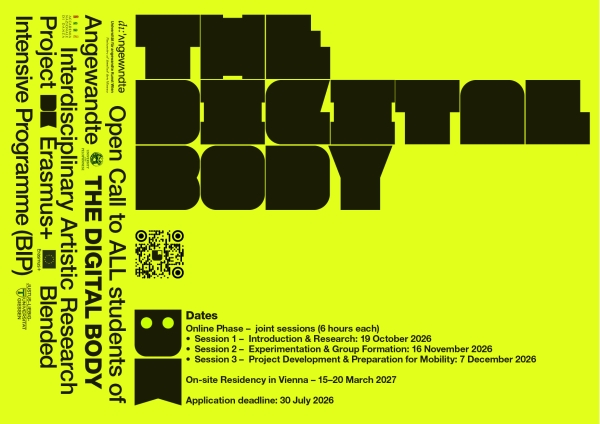
This
European collaboration is creating a shared experimental space where digital arts, theatre, and dance meet. It´s an opportunity
to connect internationally and explore the relationship between the body and digital environments. 10 spots are exclusively
reserved for Angewandte students from all departments.
Project at a Glance- The Theme: An interdisciplinary artistic research project exploring the intersection of the body and digital spaces.
- The
Format: An Erasmus+ Blended Intensive Programme (BIP) combining three joint online sessions in late 2026 and a one-week intensive
on-site residency in Vienna in March 2027.
- The Community: A collaboration between four European universities (Vienna,
Giessen, Peloponnese, Rome). You will work alongside a total cohort of 30 students.
The Digital
BodyThe Digital Body is an interdisciplinary artistic research project exploring the relationship between
body and digital environments.
Bringing together students of digital arts, theatre, and dance from four European
universities, the project creates a shared experimental space where different practices meet, interact, and transform one
another.
Through collaboration, participants develop a common vocabulary — a set of communication tools grounded
in practice, experimentation, and reflection.
Project lead: Sara de Santis, Digitale Kunst Department [DK]
Partner
Institutions: The Digital Body brings together four universities across the EU:
- University of Applied Arts Vienna
(AT) — Department of Digital Arts [DK] — host institution
- Justus Liebig University Giessen (DE) — Institute for Applied
Theatre Studies
- University of the Peloponnese (GR) — Department of Theatre Studies
- National Academy of Dance
in Rome (IT)
Who can applyThis call is for students of the Angewandte — from all departments.
Students who bring existing know-how in a technology of their choice and are eager to engage in practice-based, collaborative
teamwork.
We would like you to bring know-how in a technology you want to use. We work with tech, we don’t
teach it. Which technology is up to you.
Participation means committing to all phases of the project: the three
online sessions and the residency week in Vienna.
What we offer
- Collaboration
with 20 students travelling to Vienna from our three partner universities
- A hybrid learning format combining online
sessions, remote collaboration, and an intensive on-site residency
- Mentoring by professionals from different disciplines
- A
collaborative, peer-to-peer learning environment
- The opportunity to present work in a public format (Open Lab)
Structure of the Programme
- Online Phase — three joint research sessions with all four universities
(see Dates below)
- On-site Residency in Vienna — one week with the full cohort of 30 participants
- Public Sharing
— Open Lab format at the end of the residency week
Working Method
Participants
will:
- collaborate in interdisciplinary groups
- explore the translation between body and digital systems
- engage
in practice-based research
- contribute to a shared digital archive
Dates
Online
Phase — joint sessions (6 hours each)
- Session 1 — Introduction & Research: 19 October 2026
- Session
2 — Experimentation & Group Formation: 16 November 2026
- Session 3 — Project Development & Preparation for
Mobility: 7 December 2026
- On-site Residency — Vienna: 15–20 March 2027
Please submit:
- A motivational letter (1 page)
- A portfolio or examples of previous work — artistic,
practical, scientific; any form welcome
- Your ideas or concepts on how to use technology in the context of this project
Application
deadline: 30 July 2026
Format: PDF and links to projects
Selection
10
students from the University of Applied Arts Vienna will be selected, joining 20 students from the three partner universities
for a total cohort of 30.
Selection is based on:
- motivation
- openness to interdisciplinary collaboration
- diversity
of practices represented in the cohort
Notification: All applicants will be informed of the outcome by 15 August
2026.
Contact
We
are looking forward to meeting you — to the bodies, practices, and questions you will bring into this shared space.