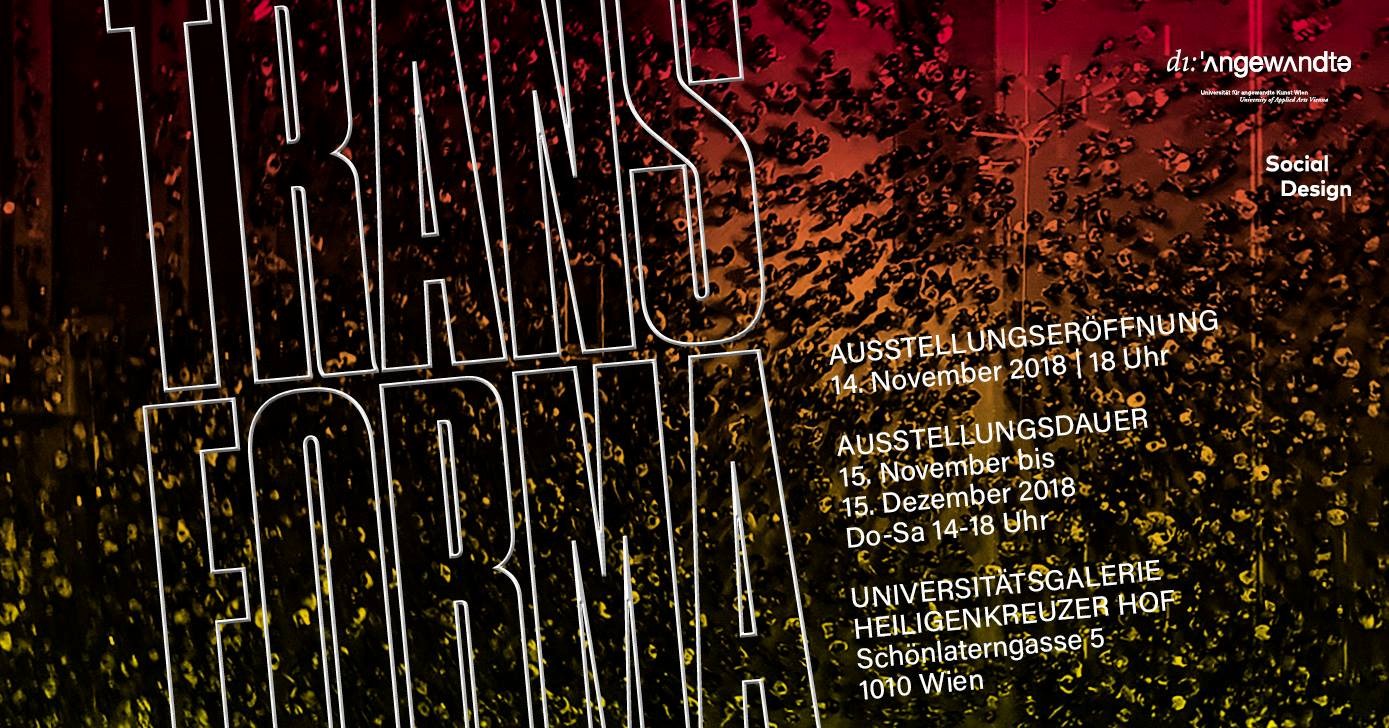
As
part of the exhibition Trans-Forma the symposium - Focus Week will be organized. It is curated by Bogomir Doringer "I Dance
Alone".
Trans-Forma starts from his tresearch on club culture as an initiator of changes, as a form of activism,
as an artistic expression where dancing is seen as an urgency in times of socio-political crisis. Collective dances and participation
are understood as a transformative mechanism of survival, but also as an individual and collective empowerment. Restrictive
political systems and social hypocrisy are giving birth to new parties, concepts and groups. The new youth is organising itself
from the dance floor, in demand for recognition and free spaces in which the curatorial agenda addresses political urgencies.
Vulnerable bodies through the state of trance experiences transform oneself or groups, further reshaping urban spaces and
structures. Urban planning and changes in cities started in increasingly involving club culture and contemporary rituals of
dancing and gathering as a way of changing spaces, reanimating dead city zones. The economic value of such gatherings is being
recognised and negotiated.
Guest speakers:
Dimitri Hegemann (Tresor.Berlin (OFFICIAL)-Kraftwerk, Berlin)
Chiara Baldini (Boom Festival Official
Francois Baudson (Boom Festival Official)
Naja Orashvilii & Giorgi
Kikonishvili(BASSIANI)
Anna Vasof (University of Applied Arts Vienna)
Detroit-Berlin-Detroit
Speaker:
Dimitri Hegemann (Tresor-Kraftwerk, Berlin)
Cities develop and change over time and each new generation makes their
mark in the physical space, architectural appearance and cultural life. These transformations create new possibilities for
experimental culture and innovativeness, something that cities strive to embrace in order to attract “’the right” kind of
people, businesses and attention. Culture is becoming a vital part of strategic planning and development as well as a tool
to achieve more just and diverse cities. But within this “cultural planning”, is there room for alternative and counter cultures
to evolve and experiment? What part does alternative culture play in comparison with public art and culture institutions?
Dimitri Hegemann is a space pioneer, cultural activist and community organizer foremost known for founding the famous Berlin
techno club, Tresor. Based on his own Berlin experiences, Dimitri Hegemann will talk about the importance of alternative culture
for urban life, change and development.
We Dance Together
Speakers: Naja Orashvili (Bassiani), Giorgi Kikonishvili
(Bassiani)
In May 2018, several thousands of ravers gathered in the heart of Tbilisi/Georgia to protest the police
raid on two of the city’s most popular clubs: “Gallery” and famous “Bassiani”. The protest consisted of dancing for two days
in front of the Parliament. It was led by the White Noise Movement and it quickly gained the support of communities worldwide.
We Dance Together, We Fight Together became the slogan of this rave-o-lution. One week later anti-fascist protest took place
on streets of Berlin, it has been organized by clubs and party collective and organizers.
Gender, Ecstasy
& the Revolution
Speaker: Chiara Baldini (BOOM Festival)
We are connecting altered states with the ancient
rites of Dionysus and Cybele and ideas of safe spaces, dancing and ritual playgrounds, socio-political urgencies and the rise
and fall of such concepts in changeable political climates. More than two thousand years ago, a series of cults were spreading
across Greece and the whole ancient world, mingling prehistoric ecstatic practices with the newly born philosophical discourse.
These cults, known as the Mystery Religions, brought a much-needed wave of fresh air to those who could not find any real
spiritual meaning in the Olympian religion. They also triggered a new religious and cultural movement able to join people
from different origins beyond the ancient tribal sense of belonging, reconnect them with the ecstatic dimension of spirituality
while providing the continuation of the prehistoric cult of Mother Nature.
Loophole: Trance State Feelings
Speaker:
Anna Vasof (University of Applied Arts)
Loops are structures, the end of which is connected to the beginning. In
music, a loop is a repeating section of sound material. Short sections of material can be repeated to create patterns that
are able to produce trance state feelings. Looping patterns can also be observed in moving image illusions. In cinema, the
first known cinematic loop is over 5,000 years old. Only recently loops became popular again through the social media video
engines where users share short looping videos and animated gifs. Facebook, Instagram videos and animated gifs have usually
small data size, are only a few seconds long, display very short stories and have the ability to start over automatically.
These characteristics make looping videos ideal for the social media space where users are impatient to follow long narratives.
From one side they can attract an impatient audience but from another side, they can also cure their impatience.
Impermanence and Transiency: The State of Being Ephemeral
Speaker: Francois Baudson (BOOM Festival)
What
kind of knowledge can be extracted out of the ephemeral urbanism of music festivals?
How and why do we build ephemeral
structures? Francois Baudson has experience from building healing-areas to the dance temples of the Boom Festival since 2002.
The most visited public temples on planet Earth are related to time and spiritual traditions coming from ancient cultures.
It shows that human beings relate to spiritual traditions with the sense of ancient, outside themselves! By channelling the
manifestation of ephemeral structures, visitors of such constructions are invited to experience spirituality.
Location:
Social Design Studio
Facebook