Medientheorie: Gunalan Nadarajan, University of Michigan (Ann Arbor)
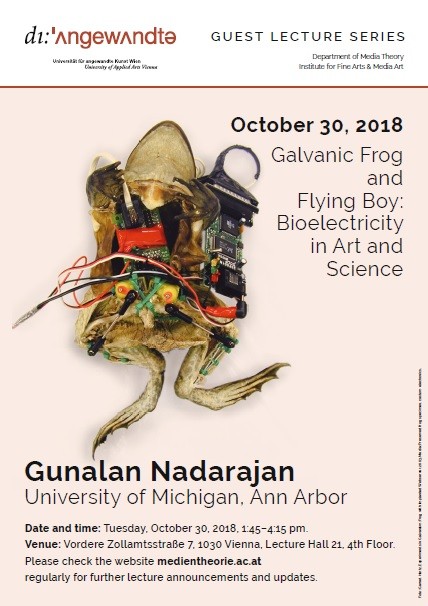
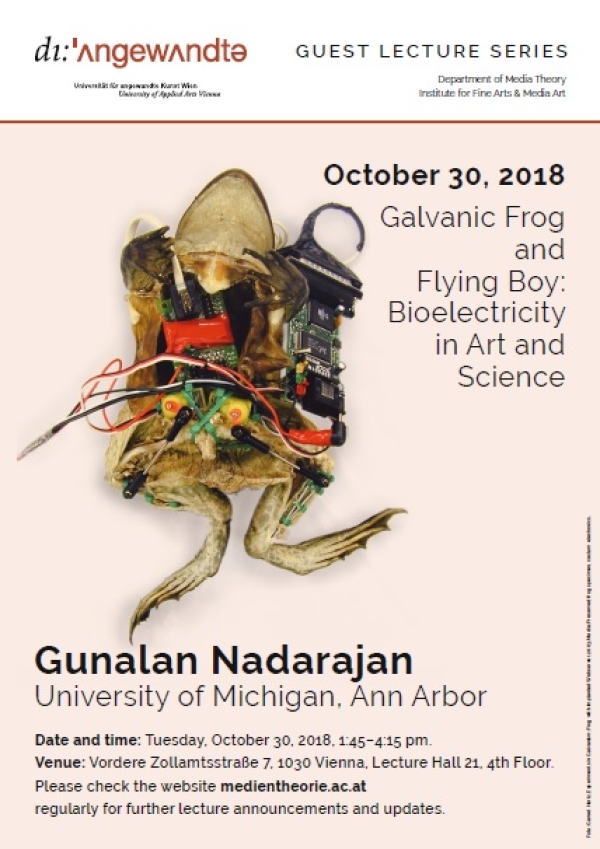
“Galvanic Frog and Flying Boy: Bioelectricity in Art and Science”
Medientheorie: Gunalan Nadarajan
Bioelectricity,
which is the capacity of living things to generate, conduct and emit electricity, has fascinated artists, scientists and the
general public alike for over two thousand years. Widely popularized as ‘animal electricity’ until very recently, this biological
capacity has been the subject of philosophical deliberation, scientific scrutiny, and artistic manipulation throughout its
history. This talk will present a historical survey of the complex interactions between the scientific studies and artistic
explorations of bioelectricity that have both expanded and problematized our understanding of biological systems.
The earliest observations of the numbing electrocuting sting of the torpedo fish by Plato leading up to
the shocking experimental studies and demonstrations of these capacities in the eighteenth and nineteenth century by Luigi
Galvani, Giovanni Aldini, B.A. Duchenne du Boulogne, Stephen Gray and John Walsh were essential to the evolving knowledge
of the physical properties and to some disparate and untoward applications of electricity including the development of the
battery, Mary Shelley’s imaginary of the Frankenstein monster, the electric chair for capital punishment, electrotherapy and
the lie detector. The talk will provide a survey of more contemporary artistic responses to bioelectricity including the electrically
stimulated body performances of Stelarc and Arthur Elsasser, the works of Richard Lowenberg, Masaki Fujihata, Eduardo Kac,
Mileece, and Ivan Henriques that tap the action potentials of plants, and Garnet Hertz and Anthony Hall who critically reenact
some of the early galvanic experiments with animals. It will be shown that the complex interactions between these co-evolving
scientific investigations and artistic uses of bioelectricity were critical to the development of a more nuanced reckoning
with the nature of biology.
Gunalan Nadarajan, an art theorist and curator working at the intersections
of art, science and technology, is Dean and Professor at the Penny W. Stamps School of Art and Design at the University of
Michigan. His publications include Ambulations (2000), Construction Site (edited; 2004) and Contemporary Art in Singapore
(co-authored; 2007), Place Studies in Art, Media, Science and Technology: Historical Investigations on the Sites and Migration
of Knowledge (co-edited; 2009), The Handbook of Visual Culture (co-edited; 2012) and over 100 book chapters, catalogue essays,
academic articles and reviews. His writings have also been translated into 16 languages. He has curated many international
exhibitions including Ambulations (Singapore, 1999), 180KG (Jogjakarta, 2002), media_city (Seoul, 2002), Negotiating Spaces
(Auckland, 2004) and DenseLocal (Mexico City, 2009) and Displacements (Beijing, 2014). He was contributing curator for Documenta
XI (Kassel, Germany, 2002) and the Singapore Biennale (2006) and served on the jury of a number of international exhibitions,
like ISEA2004 (Helsinki / Talinn), transmediale 05 (Berlin), ISEA2006 (San Jose) and FutureEverything Festival (Manchester,
2009). He was Artistic Co-Director of the Ogaki Biennale 2006, Japan and Artistic Director of ISEA2008 (International Symposium
on Electronic Art) in Singapore.
He is active in the development of media arts internationally and has previously
served on the Board of Directors of the Inter Society for Electronic Art and is on the Advisory Boards of the Database of
Virtual Art (Austria), Cellsbutton Festival (Indonesia) and Arts Future Book series (UK). He served on the Board of Directors
of College Art Association and is currently on the International Advisory Board of the ArtScience Museum in Singapore and
the Advisory Board of the New Media Caucus. He has also served as an advisor on creative aspects of digital arts and culture
to the UNESCO and the Smithsonian Institution. He continues to work on a National Science Foundation funded initiative, Network
for Science Engineering, Art and Design, to develop and support a national network for collaborative research, education and
creative practice between sciences, engineering, arts and design. In 2004, he was elected a Fellow of the Royal Society of
Art. He also served on the committee for the Integration of STEM, Humanities and Arts in Higher Education Report of The Board
on Higher Education and Workforce (BHEW) of the National Academies of Sciences, Engineering, and Medicine, USA.
He has served in a variety of academic roles in teaching, academic administration and research for over two decades.
Prior to joining University of Michigan, he was Vice Provost for Research and Dean of Graduate Studies at the Maryland Institute
College of Arts. He also had previous appointments as Associate Dean for Research and Graduate Studies at the College of Arts
and Architecture, Pennsylvania State University and Dean of Visual Arts at the Lasalle College of the Arts, Singapore.
The Guest Lecture Series of Professor Ingeborg Reichle’s lecture Art Matters: Kunst, Biologie und Medientheorie im
21. Jahrhundert is an informative and stimulating opportunity to hear from distinguished artists and experts about what’s
going on in the emerging fields of bioart, biodesign and speculative biology and also helps our students to build their network
of contacts.
Our guest lectures are open to all.