Ortsbezogene Kunst | Statement by Milica Tomić
Have We Really Loved, We Who…
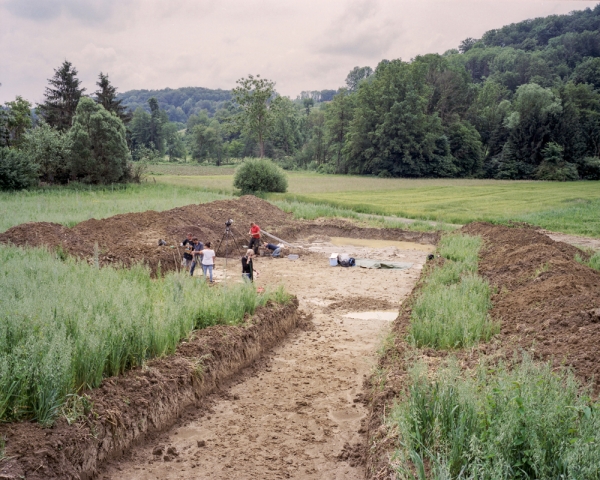
Aflenz Memorial in Becoming, 2018, archeological excavation in the site of Aflenz
an der Sulm, area of the civilian labour camp. Research photo for „Exhibiting on a Trowel’s Edge“. Photo: Simon Oberhofer
Milica Tomić' artist talk will trace how her practice
moves between research and lived experience, resisting dominant narratives to address questions of power, political violence,
and socio-economic inequality. Beginning with concrete historical events tied to the former Yugoslavia, she views them as
paradigmatic moments that make visible broader structures: how war, state power, and capital organize society, distribute
responsibility, and normalize violence within contemporary conditions of permanent war.
Works such as XY Ungelöst – Reconstruction of the Crime, Container, and Aflenz Memorial,
refuse to depict violence but reveal what makes it and what renders it invisible. These projects unfold through long-term
research and collective processes, and they insist on the inseparability of local contexts from global political and economic
systems.
A central point of the talk is that Milica Tomić work does not culminate in a single object. Each object is
a temporary knot within a broader network of relations, conversations, theory, and collective thinking. This processual logic
is inseparable from long-term collaborations, including Grupa Spomenik and Four Faces of Omarska, where
art and theory operate together as methods for investigating genocide, privatization, and postwar society as unresolved, ongoing
realities.
The video installation Portrait of MM shifts the focus toward the intimate without withdrawing from
the political. Relationships between mother and daughter become sites where history, war, and social hierarchies intersect.
Have We Really Loved, We Who… (or Is There Anything in This World You Would Be Ready to Give Your Life For?)
frames love not as the opposite of politics, but as another language for speaking about loss, responsibility, and the impossibility
of closing traumatic historical processes. In this sense, Milica Tomić' practice opens a possibility of imagining
and constructing other worlds beyond representation, beyond victimhood, and outside dominant modes of historical narration.
More information: Ortsbezogene Kunst