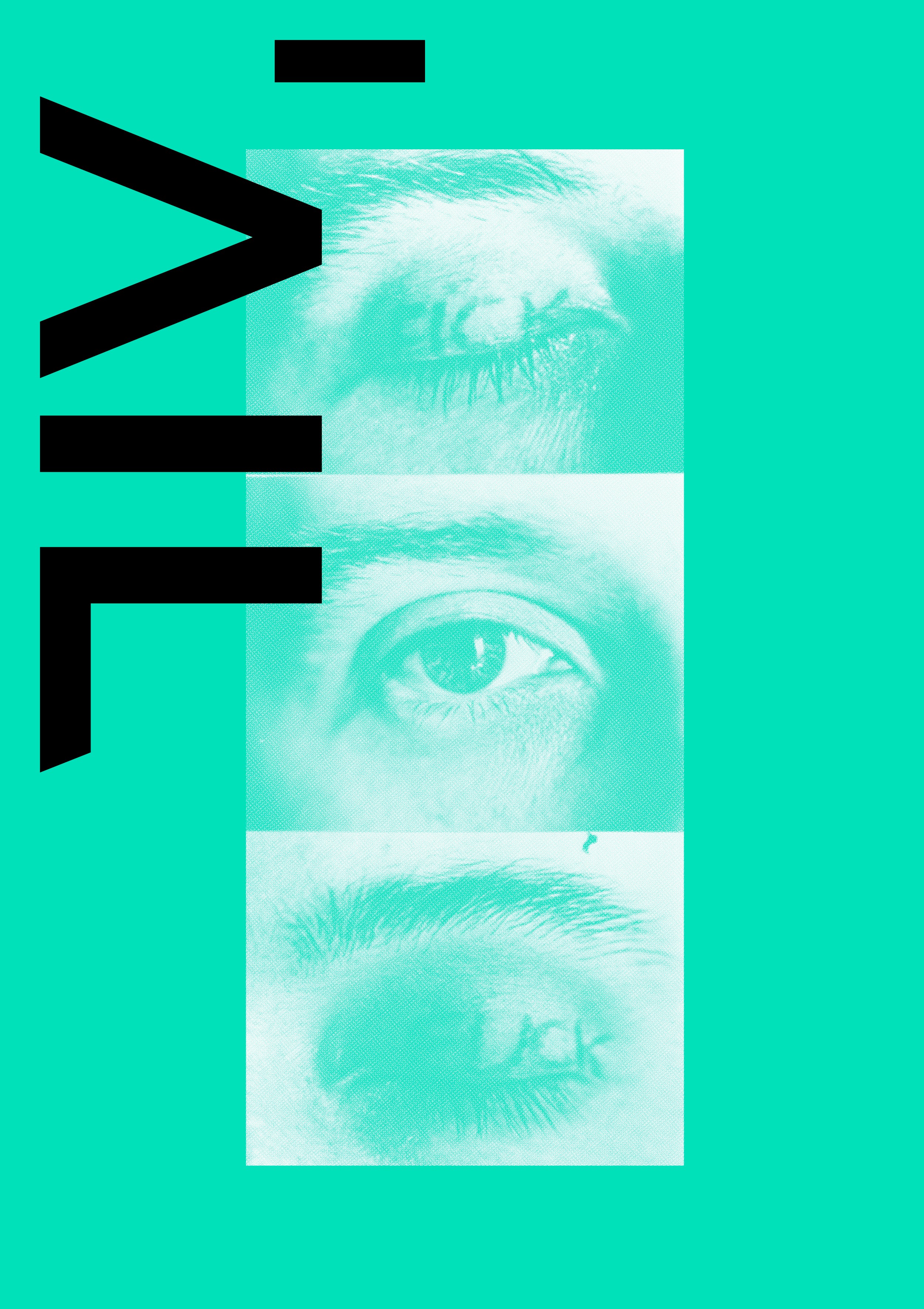
Thinking Through Weibel
Beginnings, Diversions, Elsewheres
Presented by The Weibel Institute for
Digital Cultures
Thinking Through Weibel gathers key works out of the Peter Weibel Archive, held
by the Collection and Archive at the University of Applied Arts and positions them in relation to contemporary practices by
invited international artists, that unfold through distinct conceptual and material approaches. Their contributions do not
follow or extend Peter Weibel’s logic, but move across and against it, forming intersections without fixing relationships.
Attention turns particularly to Weibel’s earlier years, when sculptural inquiries
merged with performance, film, and written language. That early period reveals a restless movement across mediums and media,
driven by a desire to test the limits of perception and to upend disciplinary borders.
The presentation highlights
the entwined currents of politics, sexuality, and playfulness that animate Weibel’s experiments. Performative actions, text
works, and spatial propositions from Weibel’s early practice appear alongside the works of the participating artists. These
juxtapositions are not structured as reflections or responses. Rather, they allow for a set of overlapping gestures, divergences,
and refusals. The exhibition stands as an open field where inquiry coexists with irreverent disruption, underscoring how creative
freedom remains inseparable from sociopolitical stakes.
Artists: Morehshin Allahyari, Nancy Baker
Cahill, Lynn Hershman Leeson, Jakob Lena Knebl, Rafael Lozano-Hemmer, Thania Petersen, Eva Schlegel, and Peter Weibel
Curated
by Valerie Messini and Brooklyn J. PakathiAdditional programme:
Talking
Through Weibel, 14 November 2025
About the Weibel Institute for Digital Cultures:
The Weibel Institute for Digital Cultures is a space for intervention, investigation, and experimentation within the expansive
disciplines of arts, science, and technologies. Based at the University of Applied Arts Vienna, the institute critically engages
digital and algorithmic cultures. Building on the rich heritage of Viennese investigations into cybernetics, net cultures,
media art, and tactical media, the institute serves as a vital node within a global network of research institutions on digital
cultures.
About Peter Weibel: Peter Weibel (5 March 1944, Odessa – 1 March 2023, Karlsruhe) was
an Austrian artist, curator, and art- and media theorist. He is perhaps best known internationally for serving as director
of the ZKM (Zentrum für Kunst und Medien in Karlsruhe), which he led from 1999 to 2023, transforming it into a globally influential
laboratory linking art, science, and society and staging landmark projects. In this position he started to reframe debates
on images, democracy, data, and ecology.
In 2017, following his donation of a substantial part of his archive to the
University of Applied Arts Vienna, the Weibel Institute for Digital Cultures was established with Weibel as founding director.
Even while mostly based elsewhere, Weibel remained a distinctly Viennese figure – woven into the city’s culture and memory.
From the 1960s, Weibel’s ties to Vienna run through study, debate, teaching, and institution-building, culminating in his
resting place: in 1964 he studied at the University of Vienna (initially medicine, then mathematics with a focus on logic);
in 1968 he participated in the famous action Kunst und Revolution at the University of Vienna; from 1976 he
taught at several institutions including the University of Applied Arts Vienna, where he was appointed Professor für Visuelle
Mediengestaltung in 1984. Between 1968 and 2014 he showed his work in various (twelve) exhibitions, founded the Hotel
Morphila Orchestra and was appointed the curator for the Austrian Pavillon at the Venice Bienniale for several years
(1993,1995,1997,1999). Part of his work is preserved in the Weibel-Archiv at the Kunstsammlung und Archiv at the University
of Applied Arts in Vienna. The state of Austria paid tribute to him by dedicating an honorary grave at the Wiener Zentralfriedhof.