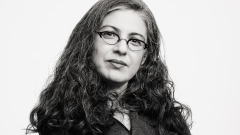
Tülay Atak
appointed professor for theory of architecture
27. May 2025
The architect and historian
Tülay Atak has been appointed professor for theory of architecture at the University of Applied Arts Vienna from october 2025.
Tülay Atak is an architect, historian and theorist whose current
work focuses on the intersections between environmental history and architecture. She received her professional architecture
degree at METU in Ankara and pursued her PhD at UCLA, with the dissertation “Byzantine Modern: Displacements of Modernism
in Istanbul.” In addition to her own research, she has participated in collaborative research projects in India and Switzerland
and worked with non-profit organizations like Cape Cod Modern House Trust and Grace Farms.
Tülay’s co-edited
book, Pedagogical Experiments in Architecture for a Changing Climate, has been published by Routledge. Her research has been
supported by the Graham Foundation and her writing and scholarship have appeared in journals such as Architectural Theory
Review, OASE, Future Anterior, Architektur Aktuell, Architect’s Newspaper, and books like Byzantium / Modernism, and Fragile
City. She curated the exhibition, Energy at the Threshold of the Visible World at AIL in Vienna.
Tülay has taught at
SCI-Arc, CalPoly Pomona, Cornell, RISD, Cooper Union, RPI and Pratt Institute. In her teaching, her goal is to bridge the
gap between history, theory and design in seminars, studios and lecture classes, emphasizing the value of design education
in finding forms to express the needs and desires of societies, in developing processes that can provide alternatives to existing
practices, and in imagining the future.
“As architects and academics, we have to think about the “worldliness”
of our profession and discipline, or how architectural ideas transform and adapt to different contexts and events. Architectural
theory can articulate the links between architecture’s disciplinary knowledge and contemporary questions. Theory can play
a foundational role in the design curriculum by tracing the transformation of architectural ideas, by articulating the links
between specific examples and their social and cultural contexts, by deepening the theoretical underpinnings of formal operations
and by mapping how the field of architecture can expand in order to address contemporary questions and diverse audiences.”
“Perhaps most importantly, architectural theory is concerned with the relationship between what ‘is present’ and what ‘can
be imagined’, allowing us to look forward and backward, and consider what remains constant and what changes in the discipline
as it addresses current challenges.”